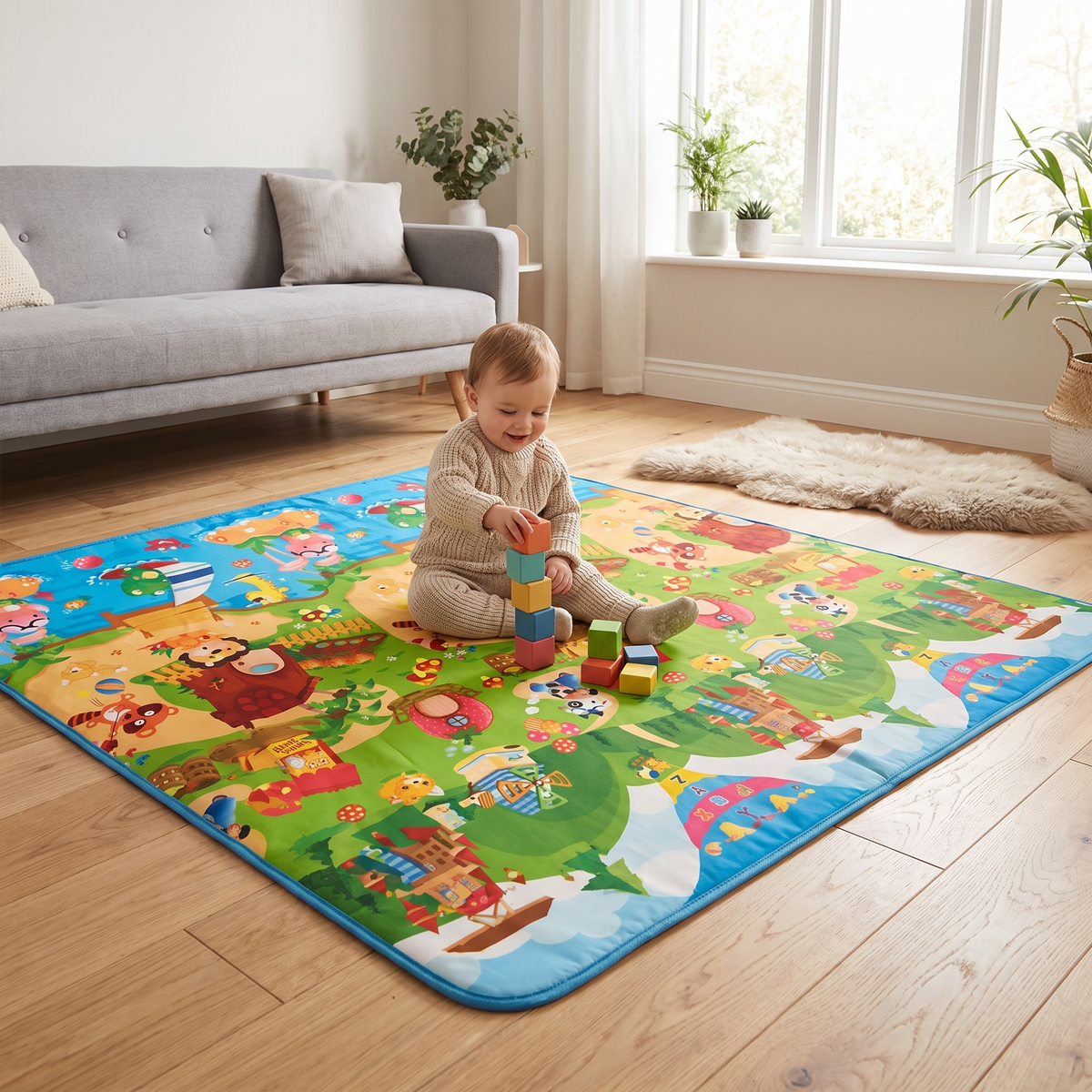
A good baby play surface does more than soften the floor. The right play mat gives your baby a clean, cushioned, inviting space for tummy time, rolling, reaching, sitting and early crawling, while making daily cleanup easier for you. This guide explains how to choose a safe, practical mat or play gym based on your baby's stage, your home and the way you actually live.
What makes a play mat safe for babies?
A safe play mat is made from infant-appropriate materials, lies flat on the floor, is easy to keep clean, and supports supervised floor play without loose hazards. For newborns and young infants, simplicity matters: the surface should be comfortable, stable and free from small detachable pieces that could become choking risks.
Start with materials. Many parents look for non-toxic fabrics and foam, organic cotton, water-based dyes, or clearly labeled baby-safe materials. If you are choosing an infant foam play mat, check that the foam is made for children's use and that the surface does not peel, flake or give off a strong chemical odor. If you prefer cotton, look for soft, washable construction and stitching that can handle frequent laundering.
Thickness is also part of safety. A thin blanket may slide on hard flooring and offer little cushioning, while an overly plush surface can be less stable for tummy time. The best baby play mat for everyday use balances softness with firmness, giving your baby support without sinking too deeply.

The main types of baby play mats
There is no single perfect mat for every family. The best choice depends on whether you need cushioning, portability, sensory play, easy storage, or a mat that blends into your living room.
Foam mats for cushioning and floor protection
Foam options are popular because they create a padded barrier between baby and hard floors. A baby play mat foam surface makes tummy time, rolling and sitting practice more comfortable, especially on tile, hardwood or laminate. Larger foam mats also give mobile babies more room to explore without immediately leaving the protected area.
Common foam-style mats include foldable mats, roll-up mats, puzzle tiles and reversible mats with décor-friendly prints, like our 1-inch-thick interlocking foam tiles and our large reversible play mat. Foam mats are usually wipeable, which helps when drool, spit-up, crumbs and diaper leaks become part of daily life. The tradeoff is that some foam mats are bulky, and puzzle seams can collect dirt if they are not cleaned regularly.
Cotton and quilted mats for softness and washing
Cotton or quilted mats are a strong choice for families who value softness and portability. They are easier to fold, carry from room to room or pack for visits. A playmat for newborn use may be a quilted style, like our padded cotton-filled floor mat, if your baby is mostly lying on their back, practicing tummy time or reaching for simple toys.
The main limitation is cushioning. Cotton mats may not absorb bumps as well as foam, so they work best on carpet, layered over another firm surface, or before your baby becomes very mobile. Always check whether the whole mat is machine washable or only certain parts.
Activity gyms for sensory development
A play gym combines a mat with overhead arches, hanging toys, mirrors, textures, sounds or high-contrast patterns. These features encourage reaching, visual tracking, batting, kicking and early hand-eye coordination. For young babies who are not yet rolling far, an activity gym like our kick and play piano gym or musical activity gym makes short floor sessions more engaging.
As your baby grows, the overhead arch becomes less useful than the floor space itself. Some gyms let you remove the toys or arches, or come with a padded fence for sitting and crawling play, like our activity gym with padded fence. That flexibility extends the product's use beyond the newborn stage.
A practical decision checklist
Before buying, picture where the mat will live and how often you will clean it. A beautiful mat that is hard to wipe down becomes frustrating, while a travel-friendly option may feel too small for daily crawling practice.
- For hard floors: choose a thicker foam or padded mat that cushions knees, elbows and early tumbles.
- For small spaces: look for a foldable play mat that stores behind a sofa, under a crib or in a closet.
- For playpens: measure carefully and choose a playpen mat that fits snugly without curling at the edges.
- For travel or grandparents' homes: pick a lightweight mat that folds compactly and wipes clean quickly.
- For décor-conscious rooms: consider reversible mats, muted colors or rug-like children's play mats that still meet baby-use needs.
- For frequent messes: prioritize wipeable surfaces, removable covers or machine-washable fabric.
- For long-term use: choose a larger mat that still works when your baby starts rolling, crawling, cruising and playing with blocks.
How do you match a mat to your baby's stage?
Match the mat to what your baby is practicing now, then choose enough flexibility for the next stage. Newborns need a clean, comfortable place for short supervised floor time, while older babies need more space, grip and cushioning as they roll, pivot, sit and crawl.
Newborn stage: keep it simple. Look for a soft but firm surface, washable materials and optional high-contrast toys or cards. Sessions are short, and the goal is comfort, bonding, visual interest and gradually building tolerance for tummy time.
Rolling stage: space matters more. A small activity mat can feel restrictive when your baby keeps ending up half on and half off the mat. This is when a larger play mat or foam option gives your baby room to move without constantly being repositioned.
Crawling stage: focus on durability and traction. The mat should not bunch, slide or separate easily. If you use foam tiles, inspect the seams often. If you use a fabric mat, make sure it stays flat and does not create folds a crawling baby could trip on.

Comparing common choices by use case
Instead of searching for one universal "best", choose the best baby play mat for your space, floor type, cleaning style and your baby's developmental stage.
| Mat type | Best for | Strengths | Watch-outs |
|---|---|---|---|
| Foldable foam mat | Daily floor play in living rooms | Cushioned, wipeable, easy to open and close | Can be bulky to store |
| Foam tile mat | Custom spaces and larger areas | Adjustable size, good coverage | Seams need cleaning; tiles may separate |
| Cotton quilted mat | Newborn lounging and portable use | Soft, washable, easy to fold | Less shock absorption on hard floors |
| Activity gym | Early sensory play | Encourages reaching, looking, kicking and tummy time | May be outgrown faster than a larger mat |
| Playpen mat | Contained play zones | Pads the playpen floor | Must fit correctly to avoid gaps or curling |
A larger mat is often better for a baby who is close to crawling, while a smaller gym may be enough for early newborn floor sessions. If you want one purchase to last longer, choose a design that can shift from baby gym to open floor mat. For a contained play zone, pair a mat with a padded playpen.
Cleaning and maintenance that fit real life
Babies bring moisture, crumbs, lint, pet hair and mystery smudges to every surface. A mat that is easy to clean is not a luxury; it is what keeps it usable every day.
For wipeable mats, clean spills promptly with a baby-safe cleaner or mild soap and water, then dry the surface before the next play session. Pay attention to fold lines, textured surfaces and tile seams where residue settles. If the mat has printed surfaces, avoid harsh scrubbing unless the care label allows it.
For fabric mats, check the washing instructions before the first wash. Some quilted mats can go in the machine, while others need spot cleaning. Wash detachable toys and fabric loops as directed, especially during drooling phases.
- Daily: remove crumbs, wipe drool or spit-up, and check for loose parts.
- Weekly: deep clean the surface, seams, corners and attached toys.
- After illness: wash or disinfect according to the manufacturer's care guidance.
- Monthly: inspect for cracks, peeling foam, torn fabric, weak stitching or broken toy attachments.
If a mat starts shedding, flaking, smelling strongly or losing pieces, stop using it for baby play.
Everyday safety habits matter most
Even the best-designed mat still requires supervision. Place the mat on a flat floor, away from stairs, cords, heaters, sharp furniture corners, unstable shelves and anything a baby could pull down. Avoid putting thick pillows, loose blankets or plush bedding on the mat for young infants, especially during tummy time, and never use a play mat as a place for your baby to sleep.
Keep play sessions responsive. If your baby becomes tired, frustrated or face-plants repeatedly during tummy time, pause and try again later. Short, positive sessions are more useful than long, forced stretches.
Also think about pets and siblings. Small toys from older children should stay away from infant play areas, and dangling gym toys should be checked often for secure attachment.
Choosing for registries and shared spaces
A play mat is one of the most-used items in the first year. For a registry, consider two surfaces: one cushioned mat for the main living area and one smaller washable mat for travel, the bedroom or grandparents' homes. Families with limited space may prefer one high-quality foldable mat instead of several smaller items.
Shared spaces deserve practical thinking too. In a living room, appearance may matter. In a playroom, size and durability matter more. Inside a playpen, measure carefully so there are no gaps along the sides.
The best choice is the one you will use daily
The right play mat should feel safe for your baby and manageable for you. Look for infant-safe materials, enough cushioning for your floors, a size that supports movement, and cleaning you can realistically keep up with. A mat that checks those boxes gets used more often, which means more tummy time, sensory exploration and comfortable floor play.
Browse all our play mats, play gyms and toys, with free US shipping on every order and orders sent the same day.
Frequently asked questions
When can a baby start using a play mat?
From the first weeks, for short, supervised tummy time and back play on a firm, flat surface.
Is a foam or cotton play mat better?
Foam gives more cushioning on hard floors and wipes clean easily. Cotton is softer, folds smaller and can often be washed. Many families use foam at home and a cotton mat for travel.
How thick should a baby play mat be?
For hard floors, around 0.5 to 1 inch of foam gives good cushioning while staying firm and stable for tummy time.
Can my baby sleep on a play mat?
No. Play mats are for supervised awake play. For sleep, place your baby on their back in a crib or bassinet with a firm, flat mattress and nothing else.
How do I clean a foam play mat?
Wipe it with mild soap and water or a baby-safe cleaner, pay attention to the seams, and let it dry before the next play session.


